Cationic
Chitosan’s positive charge enables interactions that most natural polymers cannot deliver—from binding and clarification to deposition and protection.
 MYKITO SCIENCES
Chitosan is a naturally derived biopolymer with a rare positive charge. That charge gives it an unusually broad range of useful interactions across health, food, agriculture and advanced materials.
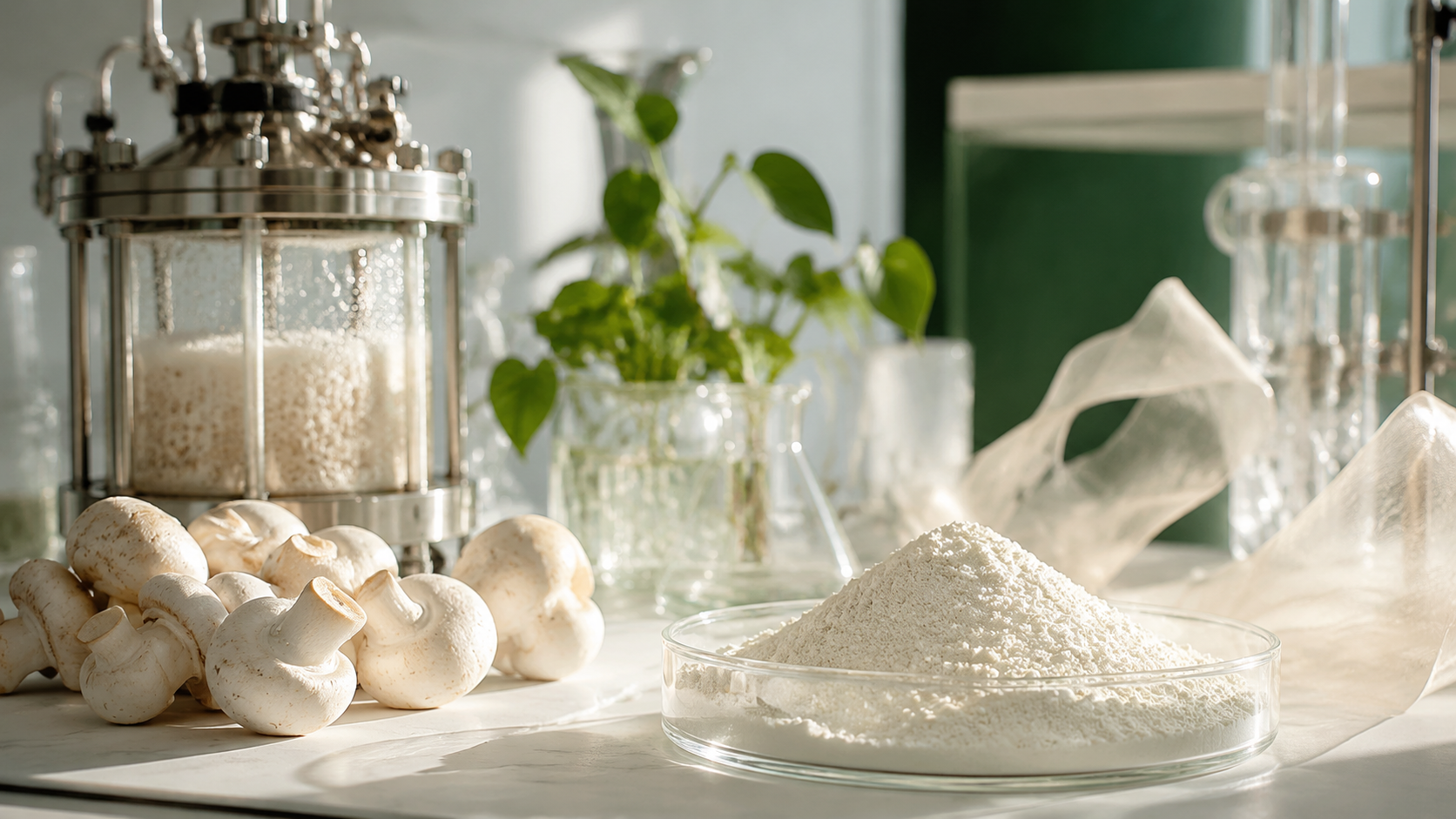
Chitosan can bind, protect, preserve, clarify and form structures—creating a functional bridge between biology and industrial performance.
Chitosan’s positive charge enables interactions that most natural polymers cannot deliver—from binding and clarification to deposition and protection.
Its biological origin and compatibility make chitosan relevant to wound care, medical materials, personal care and other sensitive applications.
Chitosan can become a powder, coating, film, fiber, hydrogel or sponge, allowing one polymer to serve many product architectures.
Mykito focuses on value without compromising material performance. Changing the source creates a more reliable foundation for customers who need consistent, traceable chitosan.
ALLERGEN RISK
A non-animal process avoids crustacean feedstocks and the allergen perceptions that can slow qualification in sensitive food, health and consumer applications.
VARIABLE QUALITY
Controlled fungal and fermentation inputs reduce the seasonal and species-driven variability of shell waste, supporting tighter molecular-weight, DDA and purity specifications.
ENVIRONMENTAL BURDEN
Conventional production requires demineralization and other chemically intensive refining steps. Mykito starts with biology selected for a shorter, more efficient path to chitosan.
REGULATORY COMPLEXITY
Defined biological inputs, lot-level testing and repeatable production create a clearer foundation for customer qualification in regulated and quality-sensitive markets.
Chitosan is abundant in nature, but its commercial value comes from a combination of charge, binding affinity, biological interaction and the ability to engineer both the molecule and its final form.
POSITIVE CHARGE
Chitosan’s defining industrial advantage is its positive electrostatic charge. It can interact with negatively charged surfaces and materials without relying on a persistent synthetic polymer.
BINDING AFFINITY
The same charge creates useful affinity for selected ions, metals, molecules, macromolecules and microorganisms—supporting functions from clarification and chelation to deposition and encapsulation.
PLANT RESPONSE
In agriculture, chitosan can act as an elicitor that initiates plant defense-response pathways. Crop, molecular specification, dose and delivery method determine the practical result.
TUNABLE PLATFORM
Molecular weight, degree of deacetylation, functional groups and formulation can be adjusted. Those variables change solubility, viscosity, charge density and efficacy in the final application.
BIOLOGICAL FIT
Chitosan is generally biodegradable and suited to biocompatible material systems. Safety, sensitization and performance still require validation for each grade, dose and finished product.
APPLICATION READY
Commercial value depends on more than making the polymer. The precise specification must be paired with the right aqueous system, blend, physical format and process conditions for the intended use.
Mykito changes the source and the process—not the powerful polymer. Controlled biology delivers a non-animal chitosan platform with the purity, consistency and tunability modern applications require.
Mykito Sciences is changing how chitosan is made. We grow selected fungi and use controlled fermentation to isolate non-animal chitosan—without relying on shrimp or crab shells.
Our ChitoGene platform goes one step further, producing chitosan directly in engineered yeast. It does not first produce chitin that must undergo chemical conversion. The result is a high-purity, precisely characterized material platform designed for repeatable performance at commercial scale.
NON-ANIMAL SOURCE
Controlled fungal and fermentation platforms remove crustacean shells from the supply chain, improving traceability and reducing the variability of seasonal animal inputs.
PURITY + CONSISTENCY
A controlled biological source enables high-purity, precisely characterized grades developed for medical, pharmaceutical, food and industrial programs.
GRAS
GRAS means Generally Recognized as Safe under specified conditions of intended food use. Eligibility depends on the identity, purity, dose and application of the specific grade.
BIOCOMPATIBILITY
Chitosan is biodegradable and suited to biocompatible material systems. Final-product biocompatibility and allergenicity must be verified for each intended medical or pharmaceutical use.
GREEN
Where formulation performance is validated, chitosan can replace or reduce selected synthetic preservatives, film formers, chelators, encapsulants and processing aids.
CO₂ OUTPUT
Biological production avoids shell demineralization and, with ChitoGene, the chitin-to-chitosan conversion step—creating a credible path to lower process intensity and CO₂ output.
FUNCTIONAL RANGE
Molecular weight, degree of deacetylation, formulation and dose determine which functions chitosan delivers in a finished product.
Natural preservative or preservative enhancer
Coatings, barriers and protective films
Antioxidative functionality in formulated systems
Binding of selected heavy metals
Interaction with lipids and fatty acids
Carrying and controlled delivery of active ingredients
Clarification and separation of suspended materials
THE MYKITO RESPONSE